Your booking cart is empty!
An approval and options workflow before hotels, guides and transport are confirmed
A private assistant can be asked to arrange a Brazil journey before the principal has chosen dates, hotels or even the balance between city, coast and nature. The danger is to send a beautiful wish list to several suppliers and receive proposals that answer different questions. A better first brief identifies who is travelling, what must be protected, which options are open, and who is allowed to approve a commitment.
Ada Tours creates tailored journeys in Brazil and wider Latin America for private travellers and travel professionals. Our agency briefing guide explains how to compare route and service assumptions. The private assistant has a narrower job: turn the principal’s preferences into a decision record without pretending that a proposed room, boat or guide is already secured.
Start with the people rather than the destination mood board. Record the traveller group, dates and flexibility, departure city, pace, privacy expectations, language needs, mobility or dietary considerations they choose to disclose, and the experiences they care about most. Mark the non-negotiable items separately from preferences. If the principal wants Rio de Janeiro but is undecided about a coast or Amazon extension, that distinction changes the proposal.
The assistant should also write down who may decide. A principal might approve the route personally but delegate hotel comparisons to an assistant. Another might ask a family member to review pace and room configuration. The brief should state the approver for each material choice and how changes will be recorded. That protects the principal from repeated questions and the supplier from guessing.

A pair of options is useful only when the differences are visible. Ask for route order, nights, internal travel, guiding, accommodation category, service basis, exclusions, cancellation conditions and the date through which an offer can be considered. A Rio stay with a private guide and a Rio stay with shared touring are not two prices for the same experience.
Our public Rio, Iguaçu and Búzios itinerary illustrates how distinct regions can sit in one journey. It is a programme example, not a commitment that its hotels, transport, activities, pricing or availability apply to a new request. A proposed option should be labelled as a proposal until every material component is confirmed.
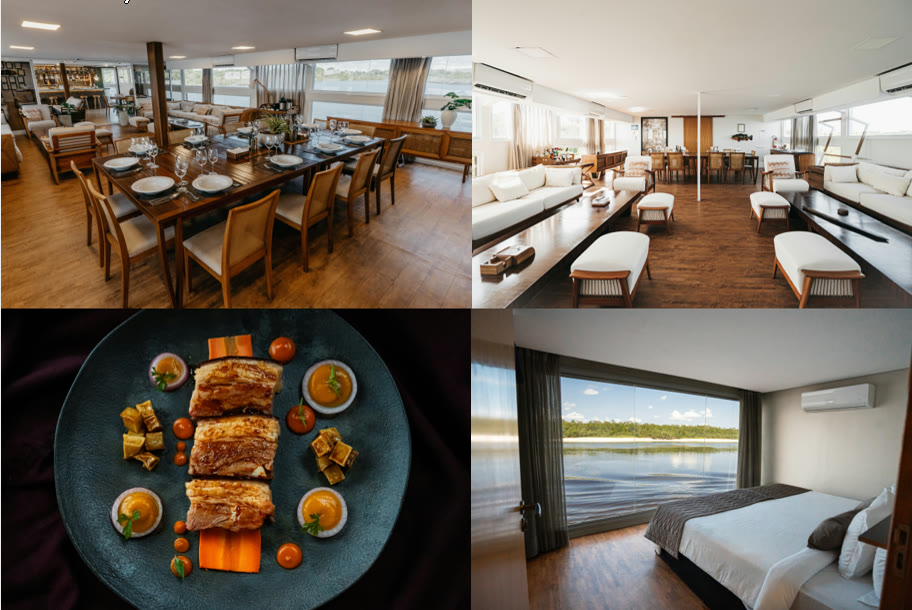
A photograph of a refined cabin or lounge can help a principal explain the level of comfort they want. It cannot establish the vessel, room, berth or service that will be available on their dates. Ask the operator to distinguish a named confirmed property from a preferred property, an equivalent category and an experience that has not yet been checked.
The assistant can then approve the type of option before the booking team seeks the final supplier confirmation. If a preferred option is unavailable, the replacement should return to the same decision criteria. Substituting a different boat, room location or transfer basis without recording the difference defeats the brief.
Keep one list of decisions: route approved, nights approved, accommodation preference, private versus shared service, optional experiences, and the person who approved each item. Beside every decision, record what is still conditional. A message saying “looks good” is not enough if nobody can tell which proposal version it refers to.
The assistant should send the principal a short comparison that names the meaningful tradeoffs. An island stop might add a boat transfer and reduce time in Rio. An Amazon cruise extension might change flight timing and the number of hotel changes. The decision is not simply which image looks better; it is what the journey asks of the traveller.

A planning brief can contain names, travel dates, room preferences and personal requirements. Share only what the operator needs to assess an option and agree who will receive the full details when a booking proceeds. A sensitive dietary or mobility point should be described accurately enough to test feasibility, but it should not be circulated as a decorative detail in a broad supplier request.
There is also a communications decision. Confirm whether Ada Tours may contact the traveller directly, whether all choices pass through the assistant, and which messages the travel agency must see. Do not assume a white-label arrangement or a constant-response service because the request is private or high value. Those boundaries belong in the agreed proposal.
After the principal chooses an option, the assistant should ask for a confirmation ledger: what has actually been booked, the supplier or booking reference where appropriate, payment and cancellation conditions, and the remaining dependencies. A river journey, coastal boat or city experience should not appear as final simply because it was approved in principle.
Ada Tours can develop the proposal around the confirmed brief and identify what still needs an answer. The assistant should keep the principal on one current version and request a new approval if a material hotel, route, service or cost changes. That gives the operator room to solve practical problems while keeping the decision with the person who owns it.

Send Ada Tours a private-assistant briefing request with the traveller profile, dates or flexibility, essential choices and the person authorised to approve each next step.
Ada Tours can work from the traveller group, dates or flexibility, priorities, pace and the choices that need the principal’s approval. The assistant should label firm requirements separately from options still open to recommendation.
Ada Tours can use a mood board to understand the preferred style, but an image is not a booking confirmation. A named property and room should remain provisional until the relevant supplier confirms them.
Ada Tours can present alternatives with the same route, service and inclusion fields so the principal can see the real tradeoffs. Differences in private guiding, transport, hotel category and open items should be explicit.
Ada Tours should use the approval route agreed for the booking rather than infer authority from an informal message. The assistant and principal can decide in advance which changes require a fresh approval.
Ada Tours can agree whether communication goes to the traveller, the assistant or an agency for the specific booking. A private itinerary alone does not establish a universal direct-contact or response-hours commitment.
Ada Tours should distinguish a preferred experience from one confirmed with the relevant supplier. The final itinerary should show any remaining dependencies and the terms that apply before the traveller relies on it.